

What Made Singapore What It Is Today — 10 Lessons from Lee Kuan Yew
1- Start with reality, not excuses.
Singapore had no natural resources, no army, and limited water supply when it became independent in 1965.
2- Invest in people.
Lee Kuan Yew believed human capital is the only real resource a country without resources can rely on.
3- Make education the foundation.
Singapore built a world-class education system and adopted English as a common working language to compete globally.
4- Meritocracy over connections.
Positions were earned based on ability and performance, not family background or political loyalty.
5- Zero tolerance for corruption.
Public officials were paid competitively but punished severely for corruption, making Singapore one of the least corrupt nations.
6- Create a pro-business environment.
Singapore attracted global companies with stable policies, efficient bureaucracy, and low corruption.
7- Build world-class infrastructure.
From Singapore Changi Airport to the Port of Singapore, infrastructure became the backbone of growth.
8- Housing creates stability.
Large-scale public housing through the Housing & Development Board (HDB) enabled most citizens to own their homes.
9- Discipline and strong governance.
Lee Kuan Yew believed rule of law and social order were essential for a young nation’s survival.
10- Long-term thinking over popularity.
His philosophy was simple:
“I’m not interested in being loved. I’m interested in being effective.”
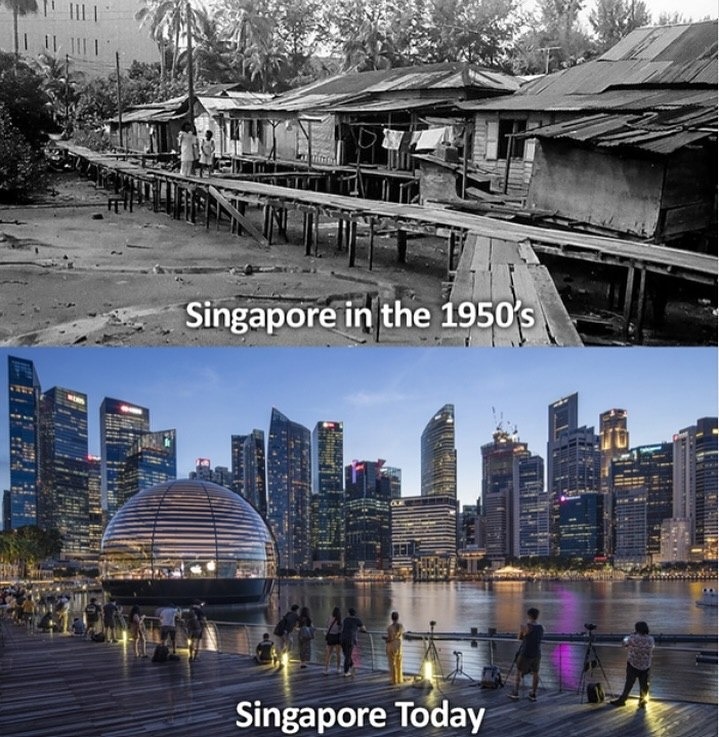
From a small trading port to one of the world’s most advanced economies, Singapore’s transformation shows what vision, discipline, and leadership can achieve.
A reminder: Nations are not built by resources alone — they are built by leadership and people.